The EU Teacher AI Training Gap: What 29.7% Means for the Future of Education
AI is already getting into the classroom in terms of homework help, lesson planning, and student study routines. But there is a gap that cannot be ignored: many teachers are still trying to understand how to use AI effectively for teaching.
A new European Commission review, according to TALIS 2024 data, 29.7% of surveyed EU teachers had participated in professional development related to AI for teaching and learning. At the same time, four out of ten young people aged 16 to 24 in the EU used generative AI for formal education in 2025.
This creates an interesting situation. Students are already using AI, while teacher preparation is still catching up.
The question is no longer simply whether AI belongs in education. The bigger question is how teachers can use it in a way that supports learning without replacing the human part of teaching.
What Does the 29.7% Figure Actually Tell Us?
The 29.7% figure refers to EU teachers surveyed in TALIS 2024 who reported participating in professional development related to AI for teaching and learning. It does not mean that the other 70.3% have never used AI or know nothing about it. Training, personal experimentation, informal learning, and professional development are different things.
Still, the number points to a clear preparation gap.
The OECD's TALIS 2024 findings also show that skills for using AI in teaching and learning were the area with the highest share of teachers reporting a high level of professional learning need across OECD education systems.
For schools, this matters because giving teachers access to AI tools is only one part of the job. Teachers also need to understand when AI is useful, when it is not, how to check its output, and how to keep students actively involved in the learning process.
The Role of AI Tutor in Education
One of the most practical applications of AI is the AI tutor.
An AI tutor can provide students with additional support when a teacher is not immediately available. A student may ask for another explanation of a difficult concept, request an example, practise a problem, or ask a follow-up question after class.
This can be especially useful when students learn at different speeds. For a deeper look at how this type of support can work, see how AI tutors provide 24/7 learning support. Imagine a teacher explaining fractions to a class. Most students understand the lesson, but three students are still confused. In a traditional classroom, the teacher has to balance helping those students with continuing the lesson for everyone else.
An AI tutor can give those students another explanation or additional practice while the teacher continues working with the class.
That does not make the AI the teacher. It gives the teacher another way to support students.
AI Should Support Human-AI Collaboration, Not Replace the Teacher
The strongest use of AI in education is not simply automation. It is a Human-AI Collaboration.
Teachers bring things that software cannot fully reproduce. They understand their students, classroom relationships, motivation, behaviour, context, and individual needs. They also make decisions about what should be taught and how it should be taught.
AI can support some of the work around that teaching. It can help prepare learning materials, provide additional explanations, support practice, and assist with routine tasks. The European Commission notes that AI can help teachers with lesson plans, materials, and assignments, while also creating new demands for responsible and effective use.
This means teacher training should not focus only on how to operate an AI tool.
Teachers also need to learn how to question AI output, protect student information, set boundaries, and decide which tasks should remain human-led.
That is where AI literacy becomes part of teaching practice.
Why Virtual Classrooms Can Help
The AI training gap also creates an opportunity for better virtual classroom software.
A virtual classroom is more useful when it brings teaching, communication, resources, assessment, and student support into one connected environment.
Consider a student who struggles with a topic during an online lesson. A useful digital teaching environment can give the student several ways to continue learning. They can revisit a recorded lesson, practise through an assignment, ask questions, or use an AI-powered support tool where appropriate.
The advantage is not simply having more technology. It is having technology that connects to the teaching process. For schools and training institutes that are planning their setup, this virtual classroom setup guide can help explain what needs to be considered before choosing and implementing a platform.
For online teaching, this matters because the teacher cannot always see what happens after a live class ends. A student may leave the session still confused but never ask for help.
Tools such as recordings, assignments, quizzes, and analytics can help create a bridge between the live classroom and the student's independent study time.
What Schools and Universities Can Do Now
The answer to the training gap does not have to be complicated.
Schools and universities can start by giving teachers practical training based on real classroom situations rather than only technical demonstrations.
For example, training can show teachers how to:
Create a first draft of lesson material and then review it for accuracy.
Generate practice questions for different ability levels.
Help students explore a difficult concept without simply giving them the answer.
Check AI-generated information before using it in class.
Teach students how to question and verify AI responses.
The goal should be confidence and good judgment, not simply higher AI usage.
Teachers should also have clear guidance from their institutions. They need to know what tools are approved, what student data can be entered, how AI should be used in assessments, and where human review is required.
The Opportunity Is Bigger Than AI Training
The 29.7% figure should not only be viewed as a problem.
It also shows where education systems can improve.
The European Commission's 2026 review found that AI policies are developing across Europe, with nearly two-thirds of education systems addressing AI through national strategies, guidance, or policy frameworks. However, implementation and access to advanced AI technologies remain uneven. That means the next stage is not simply about giving schools AI tools.
It is about helping teachers use those tools well.
For institutes, schools, and universities, this could mean building AI skills into professional development, choosing teaching software designed for online education, and giving educators enough time to experiment and learn.
For teachers, it means treating AI as another tool in the teaching toolkit rather than something that must either be accepted completely or rejected completely.
What This Means for Online Teaching
Online teaching has already changed how teachers deliver lessons. AI adds another layer to that change.
A teacher may lead the live session. The virtual classroom may provide the lesson materials and recording. An LMS can manage assignments and course information. An AI tutor can provide additional support between sessions.
Each part has a different job.
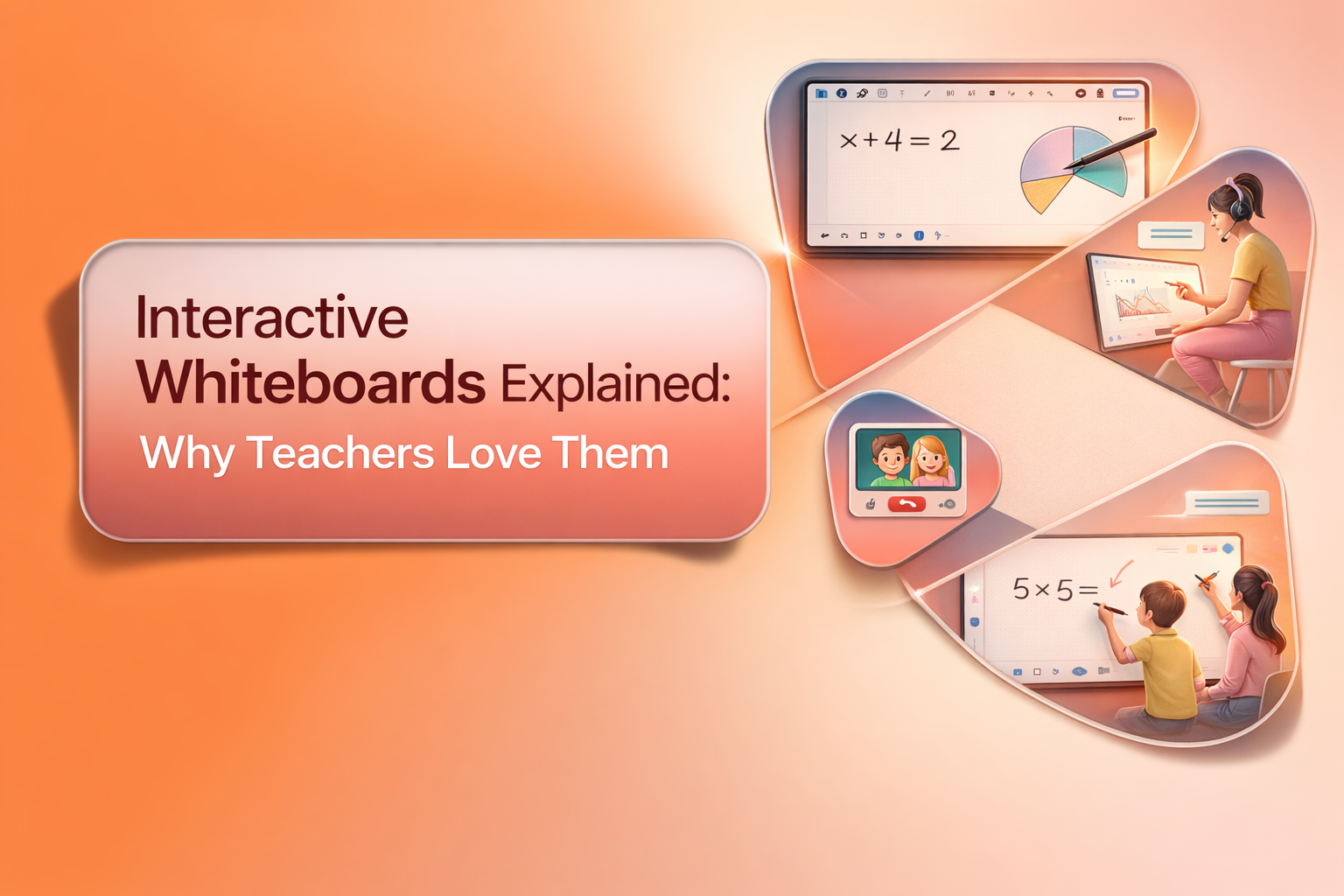
The important thing is that these tools should work around the teacher's teaching goals instead of becoming the goal themselves. For example, a teacher might use a live session to explain a new concept, a recording for review, an assignment to check understanding, and an AI tutor to help students practise. A digital whiteboard for interactive teaching can also help teachers explain difficult concepts visually during a live online lesson.
This creates a more continuous learning experience.
It also gives teachers more opportunities to focus on the work that requires human judgment.
Where Simpech Fits
Simpech Virtual Classroom is designed around the needs of teaching rather than simply providing a video meeting.
Its platform includes tools such as live teaching, a whiteboard, breakout rooms, cloud recording, assignments and quizzes, student analytics, and an AI Tutor. The Simpech Virtual Classroom brings these teaching tools into a connected online environment.
The platform's AI Tutor can provide students with additional support, while teachers remain part of the learning process. For institutes and universities exploring AI-supported online teaching, this type of connected approach can be more practical than asking teachers and students to move between several unrelated tools.
The goal should be simple: give teachers better tools without taking control away from them.
The Next Step for European Education
The 29.7% figure tells us something useful about where education currently stands.
AI is moving into education faster than teacher training is developing in many parts of Europe. Students are already using generative AI for formal education, while a relatively small share of EU teachers surveyed in TALIS 2024 had taken part in AI-related professional development.
Closing that gap will require more than buying new software.
Teachers need training. Schools need clear policies. Students need AI literacy. And technology needs to support real teaching rather than simply add another tool to an already crowded system. The role of AI tutor in education is therefore best understood as part of a larger change in how teaching works. AI can provide additional support. Teachers provide direction, context, judgment, and human connection. The opportunity is not to choose between teachers and AI. It is to build a teaching environment where both can do what they are best suited to do.
If your school, university, or institute is exploring better tools for online teaching, Simpech Virtual Classroom can help bring live teaching, learning tools, student support, and AI-assisted education into one teaching environment.
Explore Simpech Virtual Classroom and see how it can support your teaching workflow.