
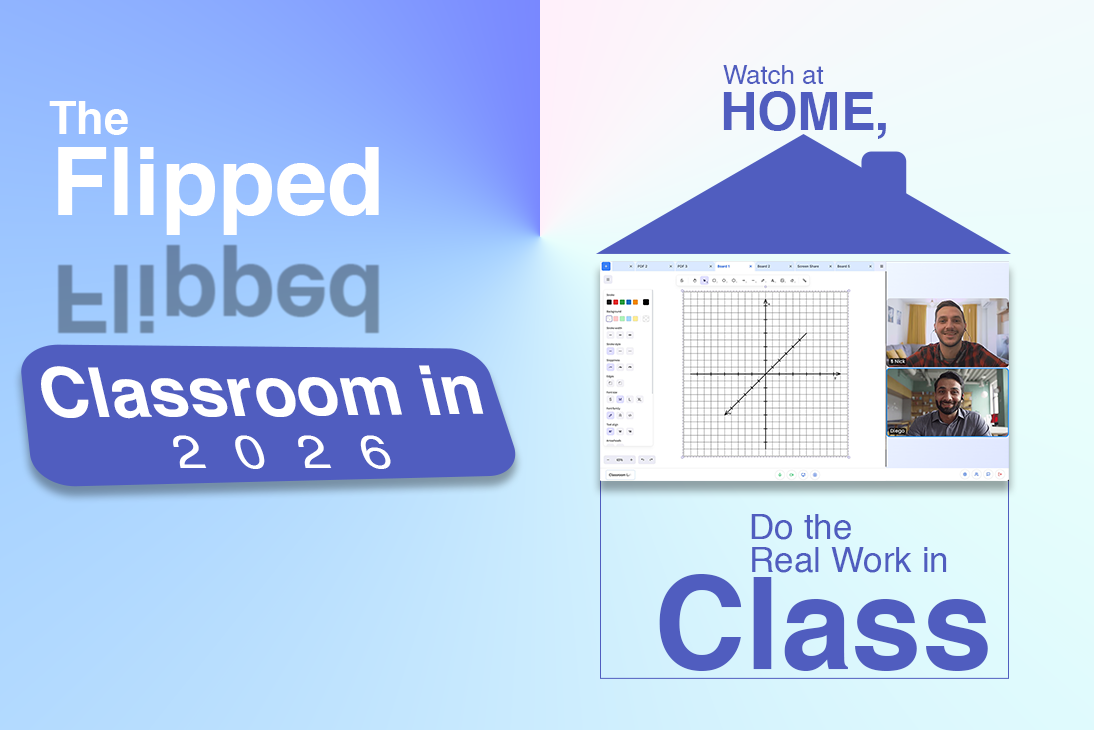
The Flipped Classroom in 2026: Watch at Home, Do the Real Work in Class
A student logs in five minutes before class starts. She has already watched two short videos. She has a question ready. She is not waiting to be taught. She is ready to think.
This is not a vision of the future. In thousands of classrooms across the world right now, this is Tuesday morning.
The flipped classroom model has been around in theory for over two decades. But in 2026, something has shifted. The tools caught up with the idea. Student expectations caught up too. And the educators who once dismissed flipping as a novelty are quietly rebuilding their entire course structure around it.
Here is why the flip is having its moment, and what it actually looks like when it works.
The Old Model Is Broken
Think about what a traditional class session actually does. The instructor talks. Students listen. The hardest part, applying what was just explained, gets sent home as homework. Students then attempt it alone, often confused, with no one to ask.
That structure has the entire thing backwards.
The easy part of learning, receiving information, happens in the room with a trained expert present. The hard part, using that information to think, solve, and create, happens alone at midnight with a textbook. No wonder so many students fall through the cracks. The model guarantees it.
Flipping the classroom fixes this by putting the passive work where it belongs, at home, and bringing the active, messy, high-stakes work back into the room where support is available.
What "Flipped" Actually Means in 2026
The basic premise is simple. Students engage with new content before class, usually through short videos or reading. Class time is then freed up entirely for doing things with that content.
But in 2026, the model has matured beyond its early version. It is no longer just "watch a video, then do a worksheet." The pre-class content is now more interactive. The in-class work is more collaborative. And the two halves are more tightly connected than ever.
Modern flipped classrooms use pre-class assignments that require students to arrive with a genuine opinion or a prepared question, not just a completed viewing log. The video is not just content delivery. It is a primer that primes the student's thinking so the live session can start five levels deeper than it used to.
The result is that class time stops being an information event and becomes a thinking event. And that distinction changes everything.
Why 2026 Is the Right Moment
Several things converged to make the flipped model more viable now than it has ever been.
Short-form content culture reshaped student expectations. A generation that grew up on YouTube tutorials and bite-sized explainer videos does not find pre-class video work foreign or unfair. Watching a well-made eight-minute video before class feels natural. Sitting through a forty-five-minute live lecture feels less so.
AI-assisted content creation also lowered the barrier for instructors. Building a library of pre-class videos used to take months. In 2026, educators can produce clean, focused video content faster and with fewer technical hurdles than before. The front-loaded effort that once made flipping feel impossible has become manageable.
And perhaps most importantly, the pandemic-era shift to online learning forced educators to separate synchronous and asynchronous content in ways they had never done before. Many of them discovered, often by accident, that students did fine with async content delivery. What students struggled with in isolation was everything else. The collaborative work. The feedback loops. The discussion. When live time returned, a growing number of instructors decided not to waste it on delivery anymore.
What Happens Before Class
The pre-class phase is where most flipped classroom attempts succeed or fail. If the pre-class content is dull, overlong, or disconnected from what happens in the live session, students stop doing it. And a flipped classroom without prepared students is just a class with an awkward silence at the start.
Good pre-class content has a few non-negotiable qualities. It is short. It covers one concept at a time. It ends with something that requires the student to do a small act of thinking, not just watching.
That last part matters more than most instructors realize. A video that ends with "see you in class" loses its grip the moment the student closes the tab. A video that ends with "before tomorrow, think about which of these two approaches you would choose and why" keeps the student mentally engaged between the video and the live session. Their brain continues processing. They arrive with something to say.
The Live Session Looks Very Different
When students come prepared, the class period opens up in ways that are almost disorienting for instructors used to the old format.
There is no need to introduce the concept. Everyone has already encountered it. So the instructor can open with a question that assumes baseline knowledge and immediately pushes into complexity. The conversation starts at a higher level. Students who might have stayed quiet in a traditional lecture find it easier to engage because they already have context.
Typical live session structures in a flipped classroom include:
Opening retrieval: A short activity where students recall what they watched, without notes, to strengthen memory before discussion begins.
Application task: A real problem, case study, or scenario that requires students to use the concept they learned at home in a new context.
Peer collaboration: Small groups work through the task together, surfacing different approaches and testing their reasoning against each other.
Instructor-led debrief: The instructor responds to what actually came up in the room rather than delivering a prepared script. The session becomes responsive rather than broadcast.
This structure is not rigid. Different subjects adapt it differently. But the underlying logic stays the same. Class time goes to the work that requires human presence. Everything else moves out.
The Instructor's Role Changes Completely
One of the most significant shifts in a flipped classroom is what the instructor actually does during live time.
In a traditional class, the instructor is the main performer. All eyes are on them. Their job is to explain clearly and hold attention. In a flipped class, the instructor is more like a coach moving around the room. Or in a virtual classroom, moving between breakout rooms and the main session.
They are listening for misconceptions. Asking follow-up questions to individual students. Redirecting groups that have gone down the wrong path. Giving real-time feedback on thinking, not just on answers.
This is harder than lecturing. A lecture can be rehearsed. A coaching session cannot. It requires the instructor to be genuinely responsive to what is happening in the room rather than executing a plan. Many instructors find this uncomfortable at first. Most find it far more rewarding once they settle into it.
The flip does not reduce the instructor's value. It concentrates it into the moments where it actually matters most.
Where It Goes Wrong
The flipped model has its failure modes, and being honest about them is more useful than pretending they do not exist.
The most common one is poor pre-class completion rates. If students do not watch the videos, the live session collapses. The instructor ends up spending the first twenty minutes recapping content, which defeats the entire purpose. Fixing this requires making the pre-class work feel meaningful and making it clear that class time will not repeat it.
A second failure mode is filling class time with more passive content instead of genuine application. Some instructors flip the delivery but not the pedagogy. They stop lecturing live but replace it with group activities that are just as passive and low-stakes as the original lecture. The physical format changed. The intellectual demand did not. Students feel the difference even if they cannot articulate it.
The third failure mode is inconsistency. The flipped model requires students to build a new habit. If the instructor occasionally skips the pre-class assignment or runs a traditional lecture session without warning, students learn that the pre-class work is optional. Once that norm is set, it is very hard to undo.
Making the Flip Work for Online Learners
The flipped classroom is not just a physical classroom strategy. In virtual settings, it may actually work better.
Online learners already navigate asynchronous content as part of their daily experience. The separation between "watch this on your own" and "come to the live session ready to work" maps naturally onto how online education is structured. There is no commute to factor in. No awkward transition from seats to group tables. The breakout room is one click away.
Virtual flipped classrooms also give instructors data that physical rooms cannot. Platform analytics can show who watched the pre-class video, how much of it they watched, and whether they completed the accompanying task. That information changes the live session before it even begins. An instructor who knows that sixty percent of students dropped off at the four-minute mark knows exactly where to spend the first few minutes of live time.
When the two halves of the flipped model are connected this tightly, by data, by design, and by a clear expectation that class time will build directly on home time, the whole structure starts to feel less like a teaching method and more like a learning system.
Getting Started Without Overhauling Everything
Flipping an entire course overnight is a reliable way to burn out and produce mediocre content. The better approach is to start with one unit, one module, or even one session.
Pick a topic that students consistently struggle with in the traditional format. Build one short, focused pre-class video around it. Design a live session task that requires students to apply that concept in a way they could not do alone. Run it. Pay attention to what happens.
Some things will not work the first time. The video will be too long or the task will be too vague. That is fine. The iteration is the point. Every cycle produces a better version.
Here is what a sustainable starting point looks like for most instructors:
Week one: Record one pre-class video of five to seven minutes. Keep it to a single concept. End it with one question students must think about before class.
Week two: Run the live session as pure application. No recap, no re-explaining. Trust the video. See what students already understand and build from there.
Week three: Review what worked. Adjust the video length or the in-class task based on what you observed. Repeat.
Building slowly and deliberately produces a flipped classroom that actually holds together. Building fast produces chaos and the convincing illusion that the model does not work.
It Is Not About the Technology
A final thing worth saying clearly. The flipped classroom is not a technology story.
It does not require expensive recording equipment, a sophisticated learning management system, or an AI-powered platform. Those things can help. But the core of the flip is a pedagogical decision, a choice about where certain kinds of learning should happen and why.
That decision is available to any instructor with a device that records video and a willingness to rethink what class time is for. The educators doing the most interesting work with this model in 2026 are not the ones with the biggest production budgets. They are the ones with the clearest thinking about what their students actually need from live time versus self-paced time.
The technology serves that thinking. It does not replace it.
Simpech is designed for virtual classrooms that move beyond the broadcast model. Whether you are building a flipped learning structure or redesigning your live sessions for deeper engagement, Simpech gives you the tools to make both halves of the flip work.