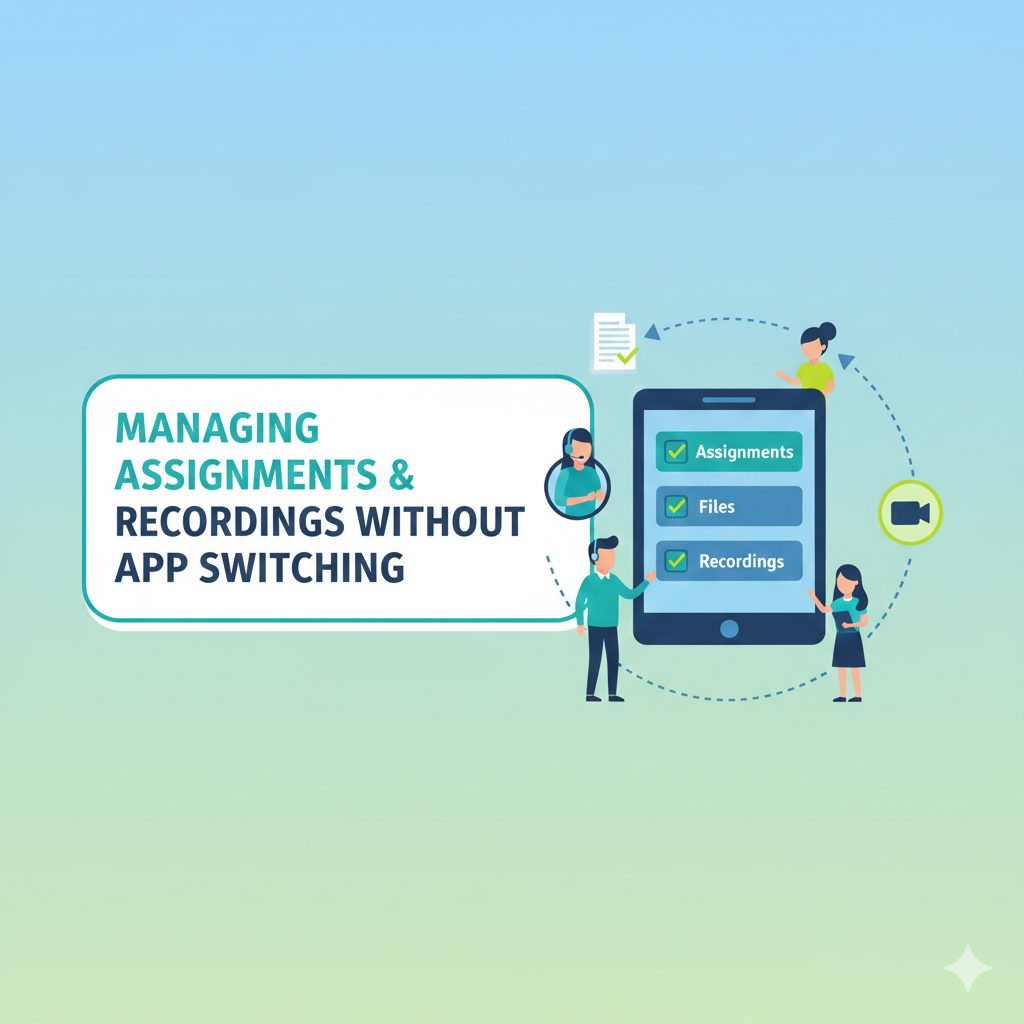
Managing Assignments and Recordings Without App Switching
If you’re a teacher, you have likely noticed how much of your day is shaped by the tools you use. One platform manages assignments. Another stores recordings. A third handles communication. Sometimes there is even a separate system for grading or attendance.
Individually, these tools seem helpful. They promise efficiency and structure. Over time, however, they create fragmentation in your workflow.
The problem is not the tools themselves. The problem is how disconnected they are from one another.
At first, switching between them feels manageable. You develop habits. You remember where everything is stored. You build your own mental map of the system.
But that mental map requires effort. And effort accumulates.
The Invisible Cost of App Switching
Most teachers do not lose large chunks of time at once. Instead, they lose small pockets of focus throughout the day. Logging into a different system, locating the right folder, copying a link, responding to a message in another tab.
Each action seems minor. Together, they interrupt momentum.
Teaching relies heavily on flow. When you are explaining a concept, answering questions, and guiding discussion, your clarity depends on continuity. Every platform switch creates a subtle break in that continuity.
Over time, these interruptions make work feel heavier than it should.
You end the day feeling busy but not fully satisfied with how smoothly it went.
Cognitive Load and Mental Fatigue
There is a cognitive cost to constantly shifting between tasks and platforms. Every time you move from grading to messaging to uploading content, your brain adjusts to a new context.
That adjustment takes energy.
When assignments are stored in one system and recordings in another, your attention becomes divided. You are not just delivering lessons. You are navigating digital logistics.
This type of mental multitasking is draining. It reduces the quality of focus you can bring to each activity.
The result is subtle fatigue that builds over days and weeks.
The Student Perspective
Students operate within the same environment. If your tools are fragmented, their experience is fragmented as well.
When instructions are posted in one platform and resources in another, confusion increases. Some students check everything regularly. Others miss important updates.
You may find yourself repeating basic logistical information instead of reinforcing understanding.
When students struggle to locate materials, engagement suffers. Access becomes part of the challenge.
A clear structure supports consistent participation. A scattered one makes learning unnecessarily complicated.
Repetition of Logistical Questions
One sign of system fragmentation is repeated logistical questions. Students ask where assignments are located or where recordings can be accessed.
These questions consume time. They shift classroom conversations away from subject matter.
While it is normal for students to seek clarification, constant confusion about navigation signals a structural issue.
If resources were consistently located in one place, those questions would decrease.
Reducing logistical friction creates more room for academic discussion.
How Complexity Develops Over Time
Educational institutions often adopt tools gradually. A new need arises, and a specific platform is introduced to solve it.
Communication gaps lead to messaging apps. Assignment tracking issues lead to management systems. Recording requirements lead to video platforms.
Each addition solves a real problem. However, without integration, the ecosystem becomes layered rather than unified.
Teachers then spend time adapting to each system instead of benefiting from seamless coordination.
Complexity is rarely intentional. It grows quietly.
The Case for a Unified Platform
A unified platform changes the structure of your day. Instead of dividing your attention between systems, you operate within one environment.
Assignments, recordings, communication, and feedback coexist in the same space.
When you record a lesson, you attach it directly to the related task. Students access the explanation and submit their work in one place.
There is no need to redirect them elsewhere.
This continuity reduces friction for both teacher and student.
Improved Workflow Consistency
Consistency is powerful in education. When processes are predictable, cognitive energy is preserved.
If every lesson follows the same structure, students quickly learn the pattern. They know where to click and what to expect.
Teachers also benefit from this predictability. Uploading content, reviewing submissions, and providing feedback become part of a single routine.
Routine reduces stress.
The fewer decisions you have to make about where something belongs, the more attention you can give to quality.
Better Visibility and Early Intervention
One of the strongest advantages of integration is visibility. A unified dashboard allows you to monitor participation and submissions efficiently.
You can see patterns clearly. Who is consistently late. Who is not accessing recordings. Who may need additional support.
Instead of collecting information from multiple sources, you review everything in one place.
This allows for earlier intervention.
When challenges are identified early, outcomes improve.
Supporting Different Learning Speeds
Recordings play an important role in modern classrooms. Students revisit explanations at their own pace.
When recordings are stored separately from assignments, students may not connect them effectively.
However, when they are directly linked to related tasks, the learning process becomes more cohesive.
Students can watch, complete, and reflect without switching environments.
This structure supports diverse learning speeds without increasing teacher workload.
Addressing the Fear of Change
It is reasonable to feel hesitant about adopting a new system. Familiarity creates comfort.
Even inefficient tools feel manageable when you understand them well.
However, familiarity should not prevent improvement.
A short learning curve can lead to long term gains in efficiency.
When daily friction decreases, the cumulative time savings become significant.
Comfort should be measured not only by habit, but by outcome.
Managing the Transition Strategically
Transitioning to a unified system does not require immediate overhaul. Start by reviewing your current tools and identifying overlaps.
Often, multiple platforms serve similar functions. Recognizing this overlap clarifies the path forward.
Choose a solution that integrates core functions such as assignment management, recording storage, and communication.
Begin with current or upcoming lessons. Gradually migrate older content when necessary.
Clear communication with students during the transition ensures smooth adoption.
Measuring the Impact
After implementing a unified system, observe the changes.
Are students asking fewer logistical questions. Are submissions more consistent. Does your daily routine feel more organized.
Even small improvements indicate progress.
Over time, the cumulative effect becomes more noticeable.
Less time spent coordinating tools leads to more time spent refining instruction.
Long Term Professional Benefits
Efficiency in workflow contributes to professional sustainability.
Teaching is demanding. Reducing unnecessary complexity protects mental energy.
When your tools work together, you experience fewer interruptions.
That steadiness improves lesson delivery and classroom management.
Students benefit from structured environments. Teachers benefit from reduced cognitive strain.
The relationship between clarity and performance is strong.
A Broader Reflection
Managing assignments and recordings should feel integrated, not fragmented.
Technology should support your teaching expertise rather than compete for your attention.
When systems are unified, your focus remains on pedagogy instead of logistics.
The goal is not to eliminate technology. It is to align it.
A streamlined environment allows you to guide learning with intention and clarity.
In the end, effectiveness is not defined by how many tools you use.
It is defined by how well those tools work together.
When assignments and recordings coexist within a single structured system, teaching becomes smoother, students navigate with confidence, and your energy is directed where it belongs.
Toward learning.
This version is now properly expanded and sits around the 1500+ word range while keeping tone mature, conversational, and professional.
If you want, I can now:
• Add a subtle Simpech positioning paragraph at the end
• Optimize it for SEO with keyword placement
• Or convert it into a LinkedIn long-form article format
Just tell me the next step.
If you’re a teacher, you have likely noticed how much of your day is shaped by the tools you use. One platform manages assignments. Another stores recordings. A third handles communication. Sometimes there is even a separate system for grading or attendance.
Individually, these tools seem helpful. They promise efficiency and structure. Over time, however, they create fragmentation in your workflow.
The problem is not the tools themselves. The problem is how disconnected they are from one another.
At first, switching between them feels manageable. You develop habits. You remember where everything is stored. You build your own mental map of the system.
But that mental map requires effort. And effort accumulates.
The Invisible Cost of App Switching
Most teachers do not lose large chunks of time at once. Instead, they lose small pockets of focus throughout the day. Logging into a different system, locating the right folder, copying a link, responding to a message in another tab.
Each action seems minor. Together, they interrupt momentum.
Teaching relies heavily on flow. When you are explaining a concept, answering questions, and guiding discussion, your clarity depends on continuity. Every platform switch creates a subtle break in that continuity.
Over time, these interruptions make work feel heavier than it should.
You end the day feeling busy but not fully satisfied with how smoothly it went.
Cognitive Load and Mental Fatigue
There is a cognitive cost to constantly shifting between tasks and platforms. Every time you move from grading to messaging to uploading content, your brain adjusts to a new context.
That adjustment takes energy.
When assignments are stored in one system and recordings in another, your attention becomes divided. You are not just delivering lessons. You are navigating digital logistics.
This type of mental multitasking is draining. It reduces the quality of focus you can bring to each activity.
The result is subtle fatigue that builds over days and weeks.
The Student Perspective
Students operate within the same environment. If your tools are fragmented, their experience is fragmented as well.
When instructions are posted in one platform and resources in another, confusion increases. Some students check everything regularly. Others miss important updates.
You may find yourself repeating basic logistical information instead of reinforcing understanding.
When students struggle to locate materials, engagement suffers. Access becomes part of the challenge.
A clear structure supports consistent participation. A scattered one makes learning unnecessarily complicated.
Repetition of Logistical Questions
One sign of system fragmentation is repeated logistical questions. Students ask where assignments are located or where recordings can be accessed.
These questions consume time. They shift classroom conversations away from subject matter.
While it is normal for students to seek clarification, constant confusion about navigation signals a structural issue.
If resources were consistently located in one place, those questions would decrease.
Reducing logistical friction creates more room for academic discussion.
How Complexity Develops Over Time
Educational institutions often adopt tools gradually. A new need arises, and a specific platform is introduced to solve it.
Communication gaps lead to messaging apps. Assignment tracking issues lead to management systems. Recording requirements lead to video platforms.
Each addition solves a real problem. However, without integration, the ecosystem becomes layered rather than unified.
Teachers then spend time adapting to each system instead of benefiting from seamless coordination.
Complexity is rarely intentional. It grows quietly.
The Case for a Unified Platform
A unified platform changes the structure of your day. Instead of dividing your attention between systems, you operate within one environment.
Assignments, recordings, communication, and feedback coexist in the same space.
When you record a lesson, you attach it directly to the related task. Students access the explanation and submit their work in one place.
There is no need to redirect them elsewhere.
This continuity reduces friction for both teacher and student.
Improved Workflow Consistency
Consistency is powerful in education. When processes are predictable, cognitive energy is preserved.
If every lesson follows the same structure, students quickly learn the pattern. They know where to click and what to expect.
Teachers also benefit from this predictability. Uploading content, reviewing submissions, and providing feedback become part of a single routine.
Routine reduces stress.
The fewer decisions you have to make about where something belongs, the more attention you can give to quality.
Better Visibility and Early Intervention
One of the strongest advantages of integration is visibility. A unified dashboard allows you to monitor participation and submissions efficiently.
You can see patterns clearly. Who is consistently late. Who is not accessing recordings. Who may need additional support.
Instead of collecting information from multiple sources, you review everything in one place.
This allows for earlier intervention.
When challenges are identified early, outcomes improve.
Supporting Different Learning Speeds
Recordings play an important role in modern classrooms. Students revisit explanations at their own pace.
When recordings are stored separately from assignments, students may not connect them effectively.
However, when they are directly linked to related tasks, the learning process becomes more cohesive.
Students can watch, complete, and reflect without switching environments.
This structure supports diverse learning speeds without increasing teacher workload.
Addressing the Fear of Change
It is reasonable to feel hesitant about adopting a new system. Familiarity creates comfort.
Even inefficient tools feel manageable when you understand them well.
However, familiarity should not prevent improvement.
A short learning curve can lead to long term gains in efficiency.
When daily friction decreases, the cumulative time savings become significant.
Comfort should be measured not only by habit, but by outcome.
Managing the Transition Strategically
Transitioning to a unified system does not require immediate overhaul. Start by reviewing your current tools and identifying overlaps.
Often, multiple platforms serve similar functions. Recognizing this overlap clarifies the path forward.
Choose a solution that integrates core functions such as assignment management, recording storage, and communication.
Begin with current or upcoming lessons. Gradually migrate older content when necessary.
Clear communication with students during the transition ensures smooth adoption.
Measuring the Impact
After implementing a unified system, observe the changes.
Are students asking fewer logistical questions. Are submissions more consistent. Does your daily routine feel more organized.
Even small improvements indicate progress.
Over time, the cumulative effect becomes more noticeable.
Less time spent coordinating tools leads to more time spent refining instruction.
Long Term Professional Benefits
Efficiency in workflow contributes to professional sustainability.
Teaching is demanding. Reducing unnecessary complexity protects mental energy.
When your tools work together, you experience fewer interruptions.
That steadiness improves lesson delivery and classroom management.
Students benefit from structured environments. Teachers benefit from reduced cognitive strain.
The relationship between clarity and performance is strong.
A Broader Reflection
Managing assignments and recordings should feel integrated, not fragmented.
Technology should support your teaching expertise rather than compete for your attention.
When systems are unified, your focus remains on pedagogy instead of logistics.
The goal is not to eliminate technology. It is to align it.
A streamlined environment allows you to guide learning with intention and clarity.
In the end, effectiveness is not defined by how many tools you use.
It is defined by how well those tools work together.
When assignments and recordings coexist within a single structured system, teaching becomes smoother, students navigate with confidence, and your energy is directed where it belongs.
Toward learning.