
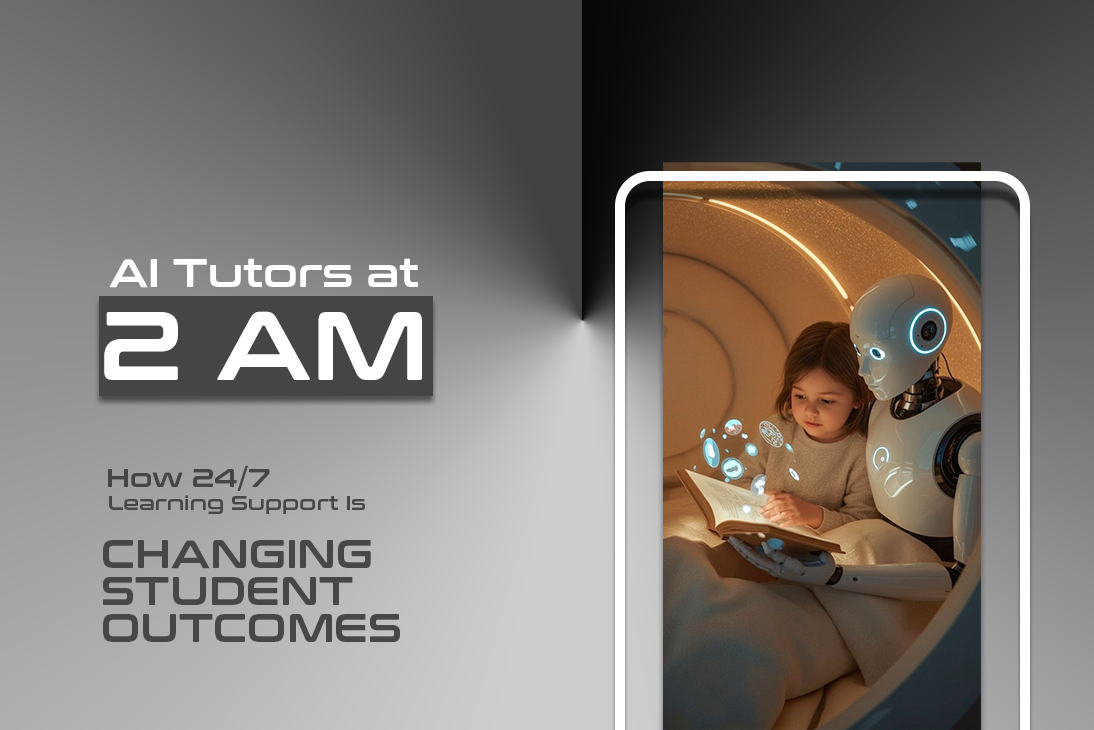
AI Tutors at 2 AM: How 24/7 Learning Support Is Changing Student Outcomes
It is 2 AM.
An exam is in seven hours. A student is staring at a concept they do not understand. Their teacher is asleep. Their classmates are asleep. The tutoring center closed five hours ago.
In the past, that student had two options. Push through the confusion and hope for the best. Or give up and go to sleep with a gap in their understanding that would show up on the exam tomorrow.
Today, that student opens an AI tutor and gets a clear, patient explanation in under a minute. They ask a follow-up question. They get another explanation. They keep going until it clicks.
That moment is not a small thing. It is one of the most significant shifts in education in decades. And it is happening right now, quietly, in bedrooms and dorm rooms and kitchen tables all over the world.
The Problem Nobody Talks About Enough
Learning does not follow office hours.
Students have been dealing with this forever. The moment confusion hits is rarely a convenient one. It happens at night, on weekends, on holidays, on the bus home when something from class that day stops making sense. And for most of education history, that confusion just sat there until a teacher was available again.
That gap, between when a student needs help and when help is available, is not a small inconvenience. Research consistently shows that immediate feedback is one of the most powerful drivers of learning. When a student gets an explanation right at the moment of confusion, the concept is far more likely to stick.
Every hour a question goes unanswered is an hour where the wrong understanding starts to solidify. By the time a teacher is available, the student has often either forgotten the question or built three other concepts on top of a shaky foundation.
AI tutors are solving a problem that has existed for as long as formal education has.
What 24/7 Actually Means for Students
The conversation around AI in education tends to focus on what happens in the classroom. The lesson design. The assessments. The teacher's workflow.
But some of the biggest gains are happening outside the classroom entirely.
A student in a time zone where live sessions happen at odd hours can now access support that feels synchronous even when it is not. A student who works a part-time job after school and only gets to studying at midnight is no longer at a structural disadvantage. A student who is too shy to ask a question in front of thirty classmates can ask the same question privately, as many times as needed, without any social risk.
These are not edge cases. These are millions of students who have historically been underserved by a system that assumes learning happens between 8 AM and 4 PM, five days a week.
The 24/7 availability of AI support does not just add convenience. It changes who gets to succeed. And that is a much bigger deal than most headlines are capturing.
What AI Tutors Are Actually Good At
This is where it helps to be specific, because AI tutors are not good at everything. And overselling them does not help anyone.
What they do well is explanation.
A student who does not understand a concept can get it explained in three different ways until one lands. They can ask for a simpler version, a more detailed version, a version with an example, a version that connects to something they already know. A good AI tutor adjusts to the student without getting frustrated, without sighing, without making the student feel like they are wasting anyone's time.
They are also good at practice. AI tutors can generate an unlimited number of practice questions at exactly the right difficulty level. They can identify which type of problem a student keeps getting wrong and focus there. They can give specific feedback on why an answer was incorrect, not just that it was.
And they are good at pace. Some students need to move slower through certain concepts. Some need to revisit things three times before they feel confident. A human tutor has time limits and other students to think about. An AI tutor has none of those constraints.
What AI tutors are not good at is the relational part of learning. The encouragement that comes from a teacher who has watched a student struggle and seen them grow. The intuition that picks up on emotional signals. The mentorship that comes from a real relationship over time.
The schools using AI tutors most effectively understand this distinction. They are not replacing human support. They are covering the hours and the volume that human support cannot reach.
The Numbers Are Starting to Come In
Early research on AI-assisted learning is producing numbers that are hard to ignore.
Students in AI-enhanced active learning environments have scored up to 54% higher on tests than peers in traditional setups. Personalized AI learning has shown the ability to improve outcomes by as much as 30%. The global AI in education market hit 7.6 billion dollars in 2025, up 46% from the year before.
These are not numbers from a press release. They are coming from studies and school district data. And they are pointing in a consistent direction.
When students get more practice, more explanation, and more feedback, they learn better. This is not surprising. What is surprising is that it took this long for technology to make that kind of support genuinely available at scale.
The schools seeing the best results are not the ones that rolled out AI and waited. They are the ones that integrated AI tutoring into a wider strategy that still involved real teachers, real relationships, and real assessment. The AI handled the volume. The teachers handled the depth.
That combination is what is moving the numbers.
How This Changes the Teacher's Job
There is an anxiety in education right now that AI tutors are coming for teaching jobs.
That anxiety is understandable. It is also largely misplaced.
What AI tutors are actually doing is changing which parts of a teacher's job matter most. The part where a teacher explains the same foundational concept for the fifteenth time this semester, that part can be handled by AI. The student can get that explanation at 2 AM without the teacher being involved at all.
What that frees up is the teacher's time and energy for the things only a teacher can do. Designing learning experiences that require human judgment. Mentoring students through difficult moments that have nothing to do with content. Facilitating discussions that go somewhere unexpected. Building the kind of trust that makes a student willing to take intellectual risks.
The teachers who will feel most threatened by AI tutors are the ones whose primary value to students was information delivery. The teachers who will thrive are the ones whose value was always in the relationship and the experience.
That shift is uncomfortable. It is also, honestly, an opportunity for the profession to reclaim what makes great teaching irreplaceable.
The Student Who Falls Behind at Night
There is a specific student worth thinking about here.
This is the student who keeps up during class. They participate. They seem engaged. But at home, without the structure of a session, without a teacher to ask, without classmates to check understanding against, the gaps start to show.
These students often do not ask for help. They are embarrassed that they need it. They do not want to bother their teacher with an email at 10 PM. They do not have parents who can explain quadratic equations or essay structure.
In a traditional system, these students fall behind quietly. By the time anyone notices, they are two weeks behind and the gap feels too big to close.
An AI tutor available at 10 PM changes that equation entirely.
The student gets the help they need when they need it. They do not have to wait. They do not have to feel embarrassed. They do not have to calculate whether they are bothering someone. They just get the explanation and move forward.
Multiply that across a semester. Across three years. Across an entire student population. The compounding effect on outcomes is significant.
What Virtual Classrooms Need to Make This Work
AI tutors do not exist in isolation. They work best when they are connected to the same ecosystem where learning is actually happening.
This is where the design of a virtual classroom platform matters.
When a student struggles with a concept covered in Tuesday's session, the ideal scenario is not that they go find a random AI tool and hope it understands the curriculum. The ideal scenario is that the AI support connected to their virtual classroom already knows what was covered, at what depth, and where this student specifically showed confusion.
That kind of integration turns a generic AI tutor into something much more powerful. It becomes context-aware support. It knows the student's history. It knows where the class is in the curriculum. It can connect the student's question to the recording of the session where the concept was first introduced.
This is the direction the best virtual classroom platforms are building toward. Not AI as a separate product bolted on from outside. AI as a layer woven into every part of the learning experience.
Real-time engagement data tells the platform which students are confused in the moment. Cloud recordings give students a way to revisit content on their own time. Analytics show teachers who is struggling before a grade reflects it. And AI-powered support fills the hours when no human is available to help.
These pieces work together. Taken apart, they are useful. Together, they are transformative.
The Equity Angle Nobody Should Skip
There is something important hiding inside the 2 AM scenario that opened this piece.
Not every student has access to private tutoring. Not every family can afford it. The student whose parents can hire a tutor for three hours before a big exam has always had an advantage over the student who had to figure it out alone.
AI tutoring does not erase that gap entirely. But it closes it significantly.
A student who has never had access to personalized academic support now does. For the first time. At any hour. In their own language if they need it. At their own pace. Without judgment.
For students in under-resourced schools, in rural areas, in time zones that make live support impractical, this is not a nice-to-have feature. It is a genuine equalizer.
The schools and platforms that understand this are not treating AI tutoring as a premium add-on. They are treating it as an access issue. And they are building it into the core of the learning experience accordingly.
Getting This Right
There are ways to do this well and ways to do it badly.
Done badly, AI tutoring becomes another passive tool that students technically have access to but never use. The platform offers it, nobody explains how to use it, and it sits untouched while students keep WhatsApp-ing classmates for help at midnight.
Done well, it becomes part of how students expect learning to work. They know it is there. They know what to use it for. They have been shown how to ask it good questions. They understand what it is good at and where they still need to go to a teacher.
The difference between those two outcomes is not the technology. It is the intentionality behind how it is introduced and supported.
Teachers who spend ten minutes showing students how to interact with an AI tutor, how to prompt it, how to evaluate its responses, how to use it as a starting point and not a final answer, those teachers see adoption. And they see the outcomes that come with it.
That ten-minute investment is one of the highest-return things an educator can do right now.
The 2 AM Moment, Revisited
Think again about that student. Seven hours before an exam. A concept that is not clicking. Nobody available.
In the old model, that student either pushed through on confusion or gave up. Either way, the gap stayed.
In the new model, that student gets help. Real help. Specific to the question they actually have. Immediately. Without judgment. For as long as they need.
And they walk into the exam with one less gap.
Now multiply that by every student in your institution. Every confused moment that used to go unanswered. Every question that felt too small to email a teacher about. Every night before a test when understanding was close but not quite there.
That is what 24/7 AI learning support is actually doing. Not replacing teachers. Not making learning effortless. Making the moments between teaching count for something.
That is a shift worth paying attention to.